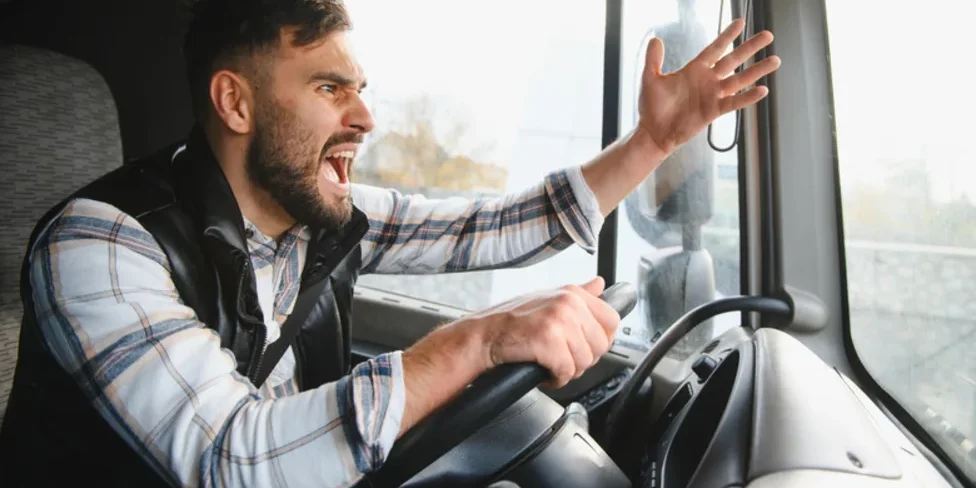
Sure, big trucks can be plenty annoying when you’re driving in a typical light-duty ride. But if you ever feel your blood boiling when you’re trapped behind a slow-moving semi, or in front of a fast-moving one bearing down on your bumper, remember: Truck drivers can get equally angry at some of the antics pulled by people in passenger vehicles. Among the worst are when car drivers put trucks into positions where their size is a key disadvantage, making the road more dangerous for both you and them.
For example, one of the most common complaints from truck drivers is that people in cars ride in trucks’ huge blind spots — which are indeed pretty big. As a result, the Federal Motor Carrier Safety Administration recommends that, if you’re traveling in the same lane as a semi, you stay at least 30 feet behind the trailer. Otherwise, it makes tailgating a big truck even more risky than when you do it to a car, since the truck won’t even know you’re there.
Plus, tall hoods and big grilles aren’t just lethal to pedestrians and cyclists. They create dangerous forward blind spots as well. With that in mind, the FMCSA extends the front “no zone” of a semi forward to 20 feet. Additionally, there are sizable blind zones extending sideways by about one lane on the driver’s side and two lanes on the truck’s passenger side. To gauge whether your vehicle is in the truck’s blind spot, the best practice is to look into the truck’s sideview mirrors. If you can see the trucker’s face, that means they can see your vehicle.